
HVAC diagnostics with numbers, not guesses.
For hot rooms, humid houses, frozen coils and new systems that never worked right: we measure the system against the manufacturer’s data and tell you what the numbers mean.
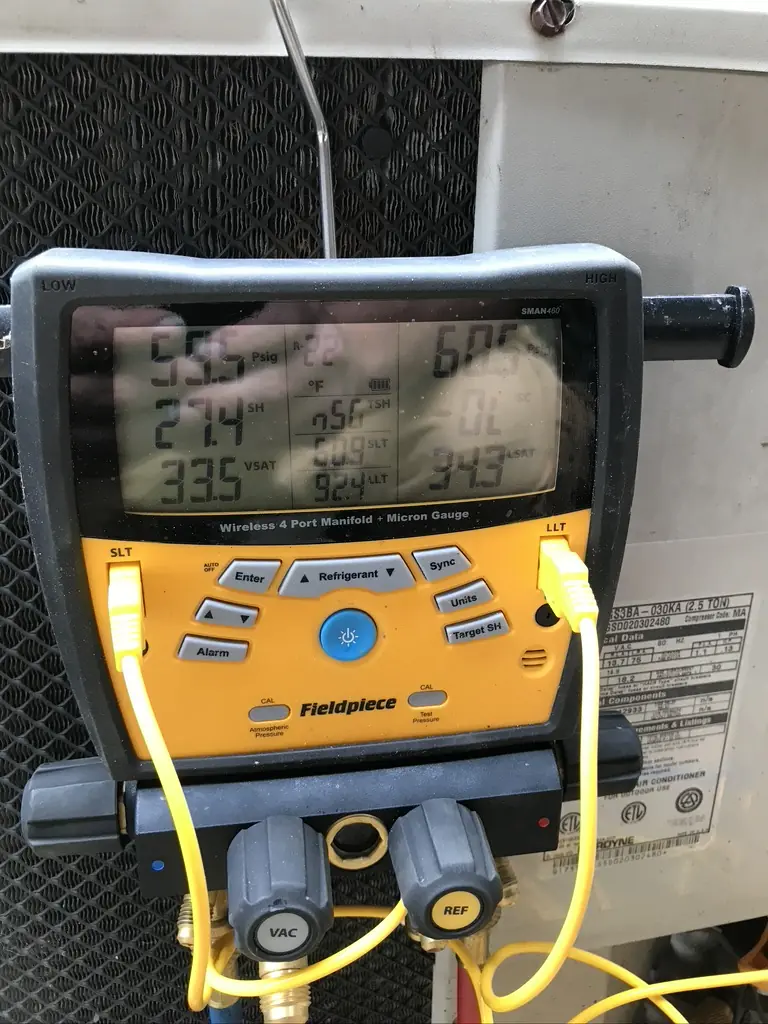
The tests behind a real diagnosis.
Each reading answers a specific question. Together they separate equipment problems from duct and building problems.
| Measurement | What it tells us | Typical tool |
|---|---|---|
| Total external static pressure | Whether filters, coils and ducts restrict airflow beyond what the blower is rated to move | Digital manometer at supply and return |
| Airflow (CFM) | Whether the system moves the air it needs, roughly 350–400 CFM per ton for many systems, adjusted for humidity goals | Blower table plus static, flow hood or flow grid |
| Superheat / subcooling | Whether the refrigerant charge and metering device are correct | Digital manifold and line-temperature clamps |
| Temperature split and humidity | How much sensible and latent cooling the coil is delivering | Psychrometer at return and supply |
| Electrical | Capacitor, motor and compressor health | Meter and clamp ammeter |
| Duct leakage | How much air escapes ducts into the attic | Duct leakage tester at 25 pascals |
| Room pressures | Whether closed doors or unbalanced returns pull in attic or outdoor air | Manometer across doors and envelope |
Airflow targets vary by manufacturer and by whether the goal is maximum dehumidification. We use the equipment’s published data.
How we read static pressure.
Total external static pressure is the pressure the blower works against outside the cabinet. It is measured in inches of water column.
Formula in words: Total external static pressure equals the supply static pressure plus the return static pressure, both taken as positive numbers.
Step 1. Supply side reads +0.48 in. w.c.
Step 2. Return side reads −0.42 in. w.c. Taken as a positive number, that is 0.42.
Step 3. 0.48 + 0.42 = 0.90 in. w.c.
Meaning. Many residential blowers are rated around 0.50 in. w.c. At 0.90, the blower table usually shows a substantial airflow drop. That points to a restrictive filter, a dirty coil, or undersized return ductwork, and it explains frozen coils and weak airflow better than a refrigerant guess.
The example numbers are illustrative. Your report uses the readings we take at your house and the blower table for your model.
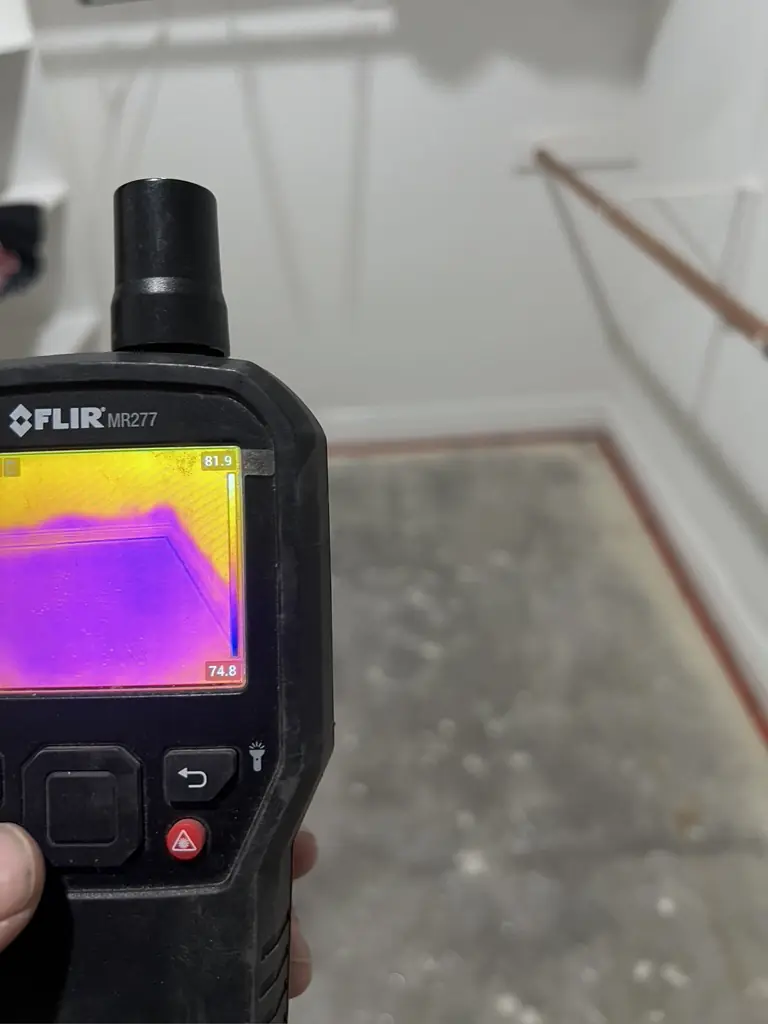
When the problem is the house.
Sometimes the equipment tests fine and the room is still hot. That is when our BPI Building Analyst credentials matter. A duct leakage test, a blower door test and infrared thermography show missing insulation, disconnected ducts and air leaks that no gauge set can find.
For builders and owners in a dispute, we keep observations, measurements and conclusions separate in the written report, and we identify any value that is an assumption so it can be replaced with a field measurement.
- Hot or cold rooms and comfort complaints
- New systems that never performed
- Frozen coils and repeat refrigerant calls
- Second opinions before replacement
Rated 4.9 on Google.
Real reviews from Houston homeowners and property owners. Read every review on Google or see more on our reviews page.
“Needed a plumber for a water leak emergency. Keith and his crew were here within 45 mins from calling. They met with the adjuster and had our home back to perfect within 2 months.”— Alex A., Yahoo Local review
“Keith is the owner, he is friendly, professional. Very detail-oriented. He makes sure everything is done correctly.”— Pam G., Angi review
“Very impressed by Keith’s skills and experience. He was able to identify and fix my plumbing issues, and was very honest about what needed to be fixed now, and what could wait.”— Thor Oxnard, Google review
Related services and guides
One call. Every trade. Any hour.
Plumbing, HVAC, water, fire, mold and building diagnostics — handled by one licensed Houston team since 2013.
Frequently asked.
Still unsure? Call (832) 904-9001 and talk to a licensed professional — not a call center.
How long does a diagnostic visit take?
Will you give me the readings?
Can you test a system another contractor installed?
Code, standard and agency references used on this page. Requirements change; confirm the edition your jurisdiction or carrier applies.